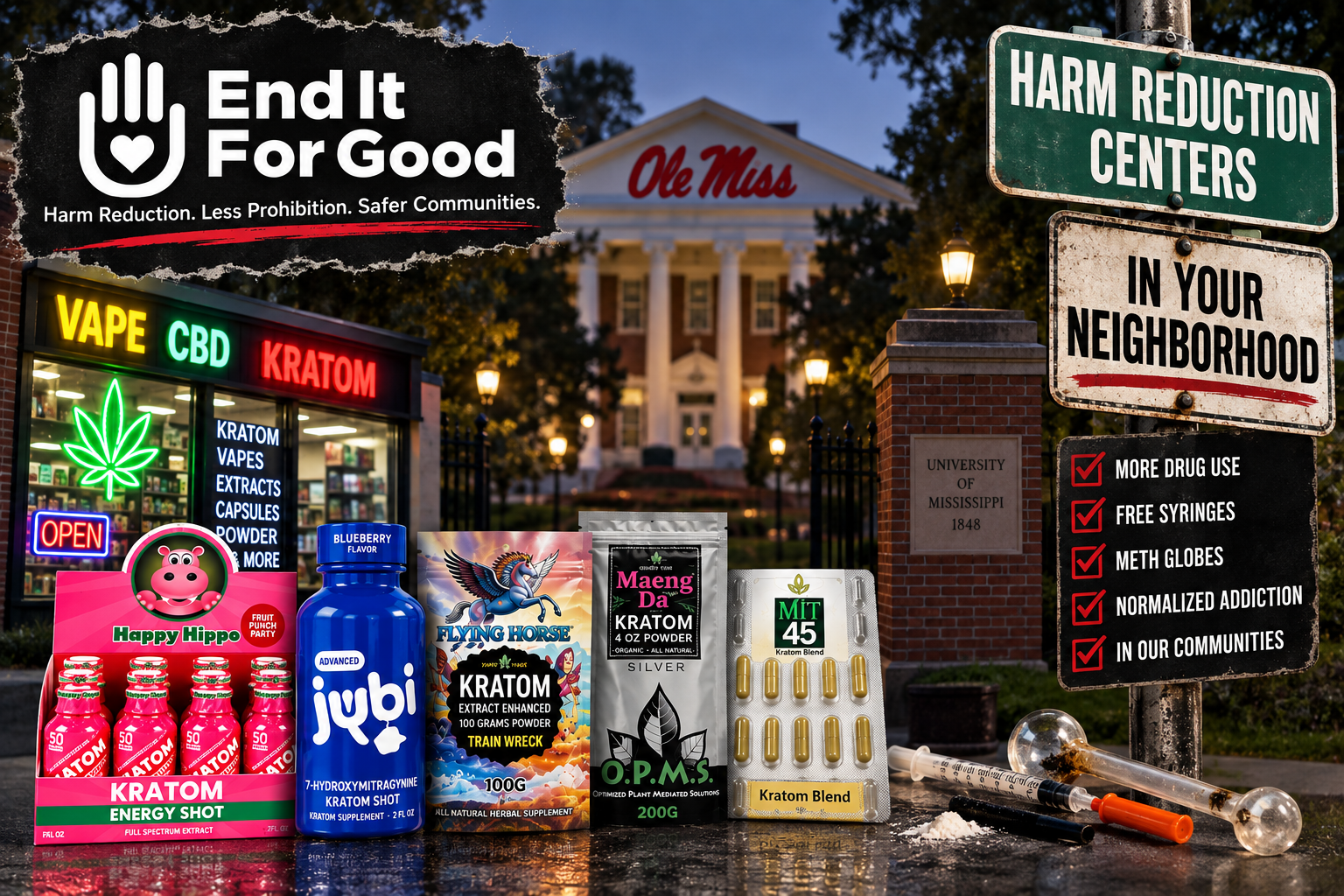
Mississippi already chose “regulation, not prohibition.” End It For Good helped campaign for that outcome, celebrated HB 1077 as “A Huge Win for Mississippi,” and thanked Rep. Lee Yancey for authoring and championing the law. Seventeen months later, two University of Mississippi students are dead and law enforcement is warning the public to avoid kratom.
What investigators have — and have not — said
Lafayette County Metro Narcotics says the deaths are being investigated separately. Authorities have not established that kratom caused either death.
But investigators disclosed that packaged kratom sold from a retail store was found during both investigations and advised the public to avoid kratom while the investigations continue.
This Is the Market Mississippi Chose to Keep
Mississippi made an affirmative policy choice in 2025: regulate kratom and leave a legal retail market in place. HB 1077 created age restrictions, behind-the-counter requirements and product rules.
End It For Good publicly supported regulation rather than a comprehensive ban. After Gov. Tate Reeves signed HB 1077, the organization called it “A Huge Win for Mississippi!”, thanked Rep. Lee Yancey for having “authored and championed” the bill, and described its preferred approach as “Regulation, not more prohibition.”
This Isn’t Just a Kratom Organization. It’s a Harm-Reduction Organization.
End It For Good’s kratom position fits its broader drug-policy philosophy. The Mississippi nonprofit advocates moving drug policy away from criminal enforcement and toward health-centered and harm-reduction approaches.
Its materials discuss naloxone, fentanyl test strips and harm reduction. Founder Christina Dent has gone further. In a February 2026 column, Dent compared illicit drugs with sports betting and argued that many reasons offered for legalizing and regulating gambling also apply to legalizing and regulating illicit drugs.

Those approaches have tradeoffs. Naloxone can reverse opioid overdoses, and syringe-service programs can reduce particular health risks. Communities are also entitled to examine the consequences of preserving legal access to psychoactive products and relying on regulators to police an evolving retail market.
“A Huge Win for Mississippi!”
End It For Good did more than publish a favorable press release. Its own account says supporters contacted legislators, kratom advocates spent two days at the Capitol, the organization held a press conference and advocates met with lawmakers.
Its website featured advocates with Rep. Lee Yancey and later published a photograph captioned “Representative Yancey & Kratom Advocates.”
There is no evidence presented here that the American Kratom Association paid End It For Good, that a kratom manufacturer funded the organization, or that Yancey was paid by a kratom company. What is documented is that End It For Good wanted kratom kept legal under regulation, organized supporters around that objective, worked publicly with lawmakers, and celebrated when the policy became law.
Then Mississippi Tried Scheduling Again
On January 19, 2026, Rep. Beth Luther Waldo introduced HB 1750, legislation that would add kratom—including mitragynine and 7-hydroxymitragynine—to Schedule III.
HB 1750 was referred to House Drug Policy and Business & Commerce.
Drug Policy gave the bill a Do Pass and transmitted it to Business & Commerce.
HB 1750 died in committee.
Business & Commerce was chaired by Rep. Lee Yancey, the same legislator End It For Good had thanked for authoring and championing the 2025 regulatory law.
The public bill history does not establish that Yancey personally stopped HB 1750. But the chronology is clear: Drug Policy advanced Waldo’s scheduling bill; it reached Business & Commerce; six days later, it was dead. Committee calendars, minutes, video and correspondence could answer what the public bill history does not.
Your Neighborhood Gets a Say Too
End It For Good frequently frames drug policy around harms experienced by people who use drugs. Those harms matter. They are not the only interests government represents.
Parents and residents have interests in what is sold in neighborhood convenience stores and how psychoactive products are marketed. Schools, employers and first responders have interests too.
There is a substantial difference between providing medical care to someone with a substance-use disorder and deciding that another psychoactive product should remain available through ordinary retail channels. Mississippi chose regulated retail access for kratom. End It For Good helped advocate for that approach and celebrated when it succeeded.
Now Police Are Saying: Avoid Kratom
This is where the 2025 victory language collides with September 2026.
Two Ole Miss students are dead. Investigators have not established that kratom caused either death. But packaged retail kratom was found during both separate investigations, and Lafayette County Metro Narcotics advised the public to avoid kratom while investigators determine what happened.
That makes End It For Good’s description of HB 1077 as a “Huge Win” worth revisiting—not because the organization caused these deaths, and not because causation has been established, but because it publicly advocated the policy choice now under renewed scrutiny.
The Questions Mississippi Should Ask Now
The immediate questions belong to investigators: What substances were present? What did toxicology show? What actually contributed to each death?
The policy questions are separate: What was inside the packaged retail kratom recovered in the two investigations? Did those products comply with state law? How frequently is retail kratom independently tested? And what happened to HB 1750 during the six days after Drug Policy advanced it?