RESEARCH LIBRARY: 100+ studies · FDA data · Poison center reports · Policy analysis → GlobalKratom.org
@AntiKratom Join the fight — follow for alerts, evidence & action calls
WANT TO KEEP
KRATOM LEGAL?
BUY A MASS
SPECTROMETER.
Legislative Brief · Effective August 26, 2026

The Bottom Line

DEA is placing mitragynine pseudoindoxyl (MP) into Schedule I. States that keep kratom legal now have to distinguish ordinary kratom from commercial products containing a federally controlled substance.

DEA: possession of “any quantity” of MP outside CSA authorization is unlawful.

That leaves lawmakers with two choices: build and continuously fund a testing-and-enforcement system capable of finding MP in retail kratom products—or adopt the simpler rule and prohibit kratom sales.

33 of 35 commercial kratom products tested contained detectable MP in one 2026 study
8 of 9 tablets contained confirmed MP in a separate 2026 study
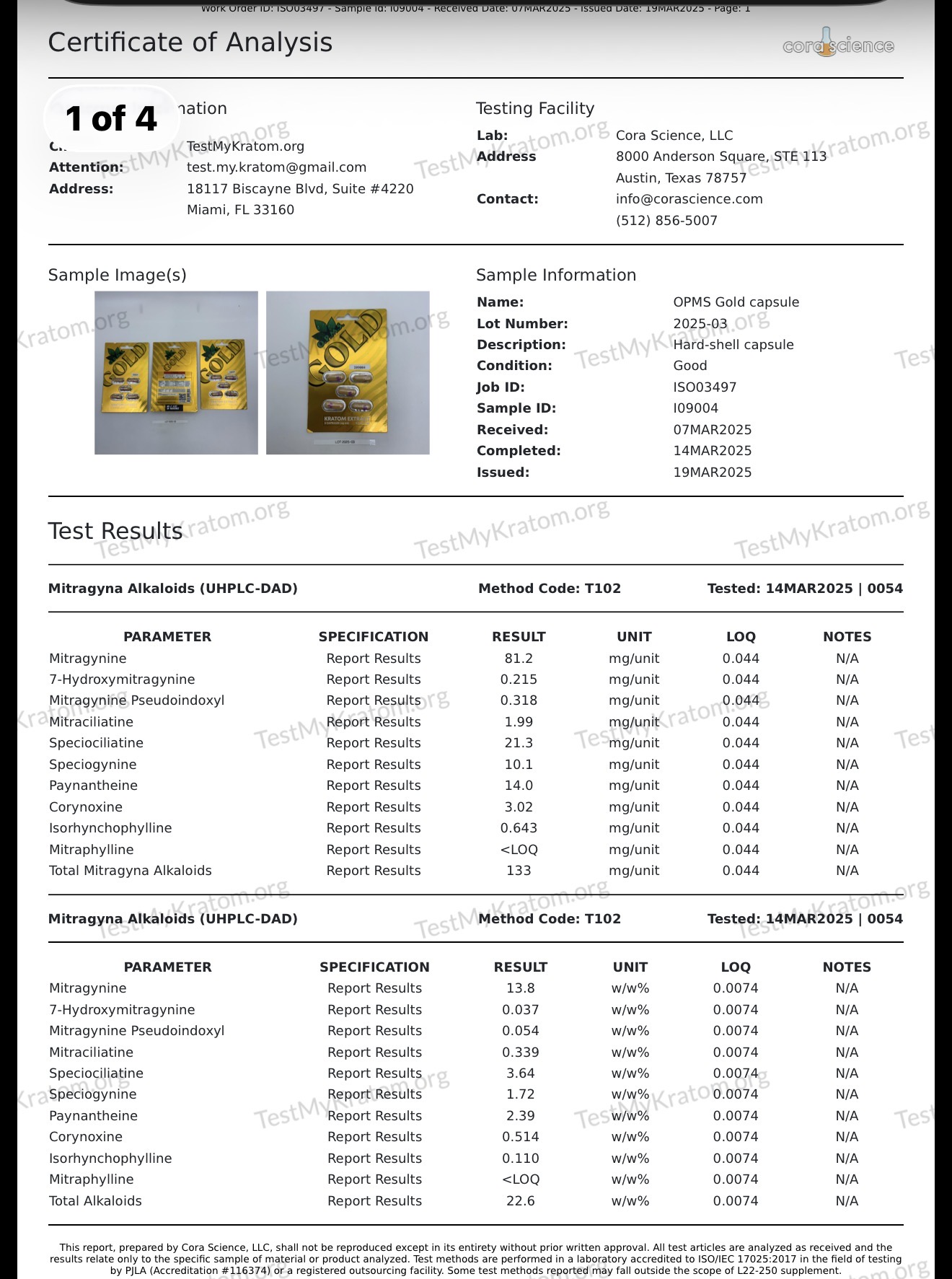
0.318 mg MP reported per OPMS Gold capsule in a supplied certificate of analysis
ANY QUANTITY DEA's possession language for MP outside CSA authorization
33 of 35 commercial products. A separate 2026 investigation tested 35 commercially available kratom products—including powders, capsules, liquids, a soft gel and tablets—and detected mitragynine pseudoindoxyl in 33 of 35. Only two products declared MP on their labels.

That finding changes the scale of the policy question. This is not simply a matter of finding an occasional package openly marketed as pseudoindoxyl. Researchers detected MP across a commercial sample set while labeling frequently failed to disclose it.

Peer-Reviewed Evidence
35-Product Commercial Kratom Study — 33 Tested Positive for MP
2026 investigation of 35 commercially available kratom products. MP was detected in 33 products; only two declared MP on their labels.
Open Study →
Primary Evidence
DEA Temporary Scheduling Order
See the section stating that retail sales of Schedule I substances to the general public are prohibited and possession of “any quantity” of MP is unlawful.
Open DEA Order →

1. Labels Cannot Solve This

A 2026 mass-spectrometry study examined authenticated kratom material and commercial products. The researchers did not confirm MP in authenticated kratom leaf—but they did confirm it in 8 of 9 tablets and 2 capsules.

8 of 9
tablets contained MP
2
capsules contained MP
1
product disclosed MP

The policy problem: a package can say “kratom,” “natural,” or “botanical.” None of those words establishes whether the finished product contains MP.

Peer-Reviewed Evidence
JASMS Commercial Product Study
Use this study to document MP detection in commercial tablets and capsules and the labeling gap.
Open Study →

2. This Is Not an Anonymous Product Problem

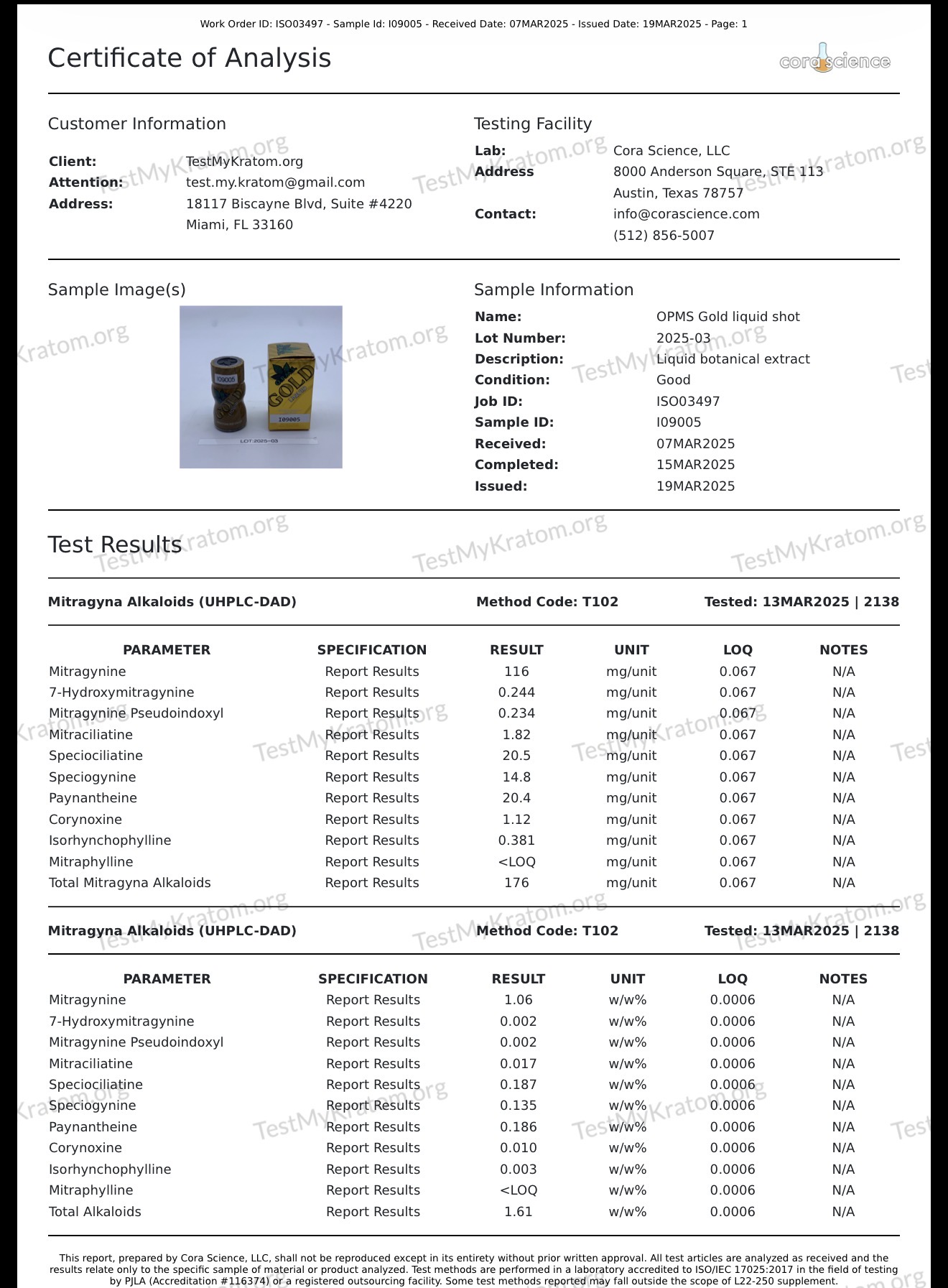
Certificates of analysis supplied for named commercial kratom products show why the issue matters at the retail counter.

OPMS Gold Capsule
0.318 mg MP / unit
The report also lists MP at 0.054% by weight.
View Certificate →
OPMS Gold Liquid Shot
0.234 mg MP / unit
The report lists MP at only 0.002% by weight.
View Certificate →
The important number is not the percentage. DEA did not create a retail MP tolerance. It scheduled the substance.

3. “Require Lab Testing” Sounds Easier Than It Is

Accurate MP identification requires appropriate analytical methods. Closely related kratom alkaloids can produce overlapping signals, and DEA itself notes that these substances require specific methods and instrumentation for accurate identification.

A certificate of analysis is not an enforcement program. Someone still has to determine whether the tested sample represents the lot being sold, whether the laboratory method can reliably identify MP, and whether products on actual store shelves match the paperwork.

4. Ask Your Regulator These Five Questions

1. Are retail kratom products currently being tested for MP?

2. Who independently samples products and verifies manufacturer COAs?

3. What validated analytical method and detection limit are required?

4. What happens statewide when a lot tests positive for MP?

5. Who pays for continuous sampling, testing, recalls and enforcement?

If the state cannot answer those five questions, it cannot credibly promise lawmakers that MP is being kept out of the legal kratom market.

5. The Simpler Legislative Option

Maintaining a partially legal kratom market means distinguishing permissible products from products containing Schedule I MP—across changing formulations, manufacturers, lots and retailers.

A prohibition draws a line that does not require a laboratory result at the point of sale:

NO RETAIL SALE OF KRATOM PRODUCTS.

No alkaloid calculations. No retailer interpreting laboratory reports. No perpetual fight over whether a product is “natural.” No state testing infrastructure simply to determine which kratom product at a gas station may contain a Schedule I substance.


The One Question to Ask Before Voting

“Tell me exactly how our state will make sure the kratom products being sold here do not contain mitragynine pseudoindoxyl.”

DEA did not schedule ordinary kratom leaf through this action. That distinction matters. But DEA did schedule MP; one 2026 study detected MP in 33 of 35 commercial kratom products, another confirmed it in 8 of 9 tablets and two capsules, and accurate identification requires laboratory analysis.

If preserving retail kratom sales requires continuous testing, validated mass-spectrometry methods, independent sampling, lot tracking, recalls and enforcement, lawmakers should ask whether the easier public-policy choice is simply to stop the sale.
Read the Federal Action
DEA — Schedule I Temporary Order
The controlling federal document behind this policy question.
Open DEA Order →