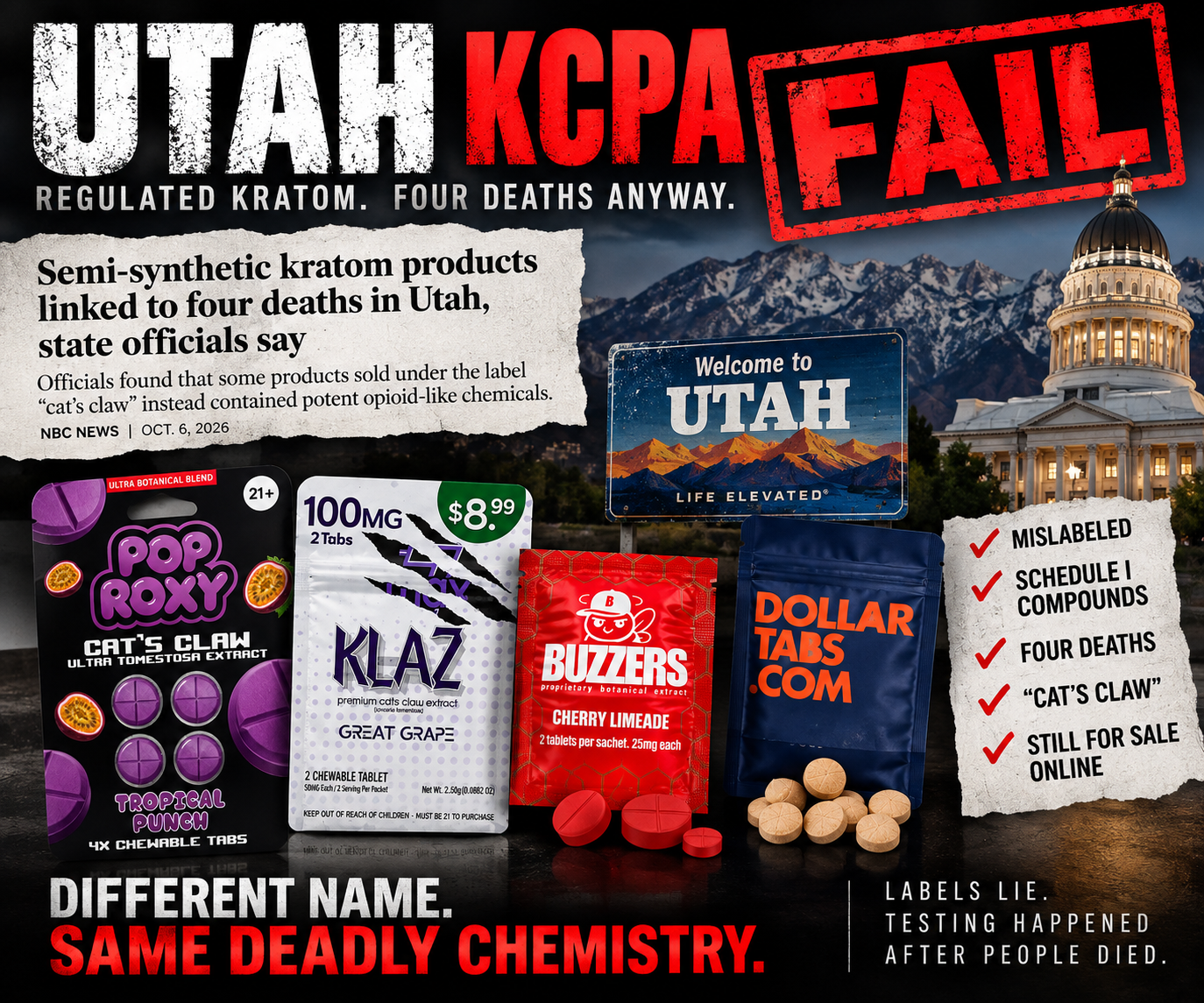
Utah officials say four deaths have been linked to potent semi-synthetic kratom compounds. Testing found mitragynine pseudoindoxyl and MGM-15 in products sold as “cat's claw.” Four deaths were linked to the compounds. Testing revealed what the labels did not.
The 30-second version
Utah had rules. MP and MGM-15 were illegal in the state and were recently placed in Schedule I by DEA.
The products did not have to confess. Officials said products were misleadingly labeled as cat's claw and could claim to be legal and free of kratom.
Testing found something else. Utah officials reported MP and MGM-15.
Four deaths were linked to potent semi-synthetic kratom compounds. One death was linked by Utah Poison Control's medical director to a Buzzers product.
Before the Deaths: Utah Was the KCPA Experiment
Utah was not late to kratom regulation. It became the first state to enact a Kratom Consumer Protection Act in 2019. The enrolled S.B. 58 created labeling requirements, prohibited certain kratom products, required product registration, established penalties and directed the Utah Department of Agriculture and Food to administer and enforce the program. The legislative record also shows American Kratom Association representative Mac Haddow assisting Sen. Curtis Bramble in presenting the bill.
Mike McKell, then serving in the Utah House, voted for S.B. 58 in committee. In 2026 he publicly called that vote a mistake and returned as the chief sponsor of S.B. 45. The original 2026 bill proposed repealing Utah's KCPA provisions, and Utah's own rulemaking record says S.B. 45 initially proposed a total kratom ban before legislative substitutes moved to a restrictive pure-leaf model.
The enacted framework went sharply upstream. Utah's Department of Agriculture and Food says that, effective May 6, 2026, products that are not “pure leaf kratom” may not be sold in Utah, extracts and products made from extracts cannot be sold, and retail sales are restricted to registered tobacco specialty businesses.
1. People Died. Then Came the Testing.
This is the part every legislature writing another Kratom Consumer Protection Act should read twice.
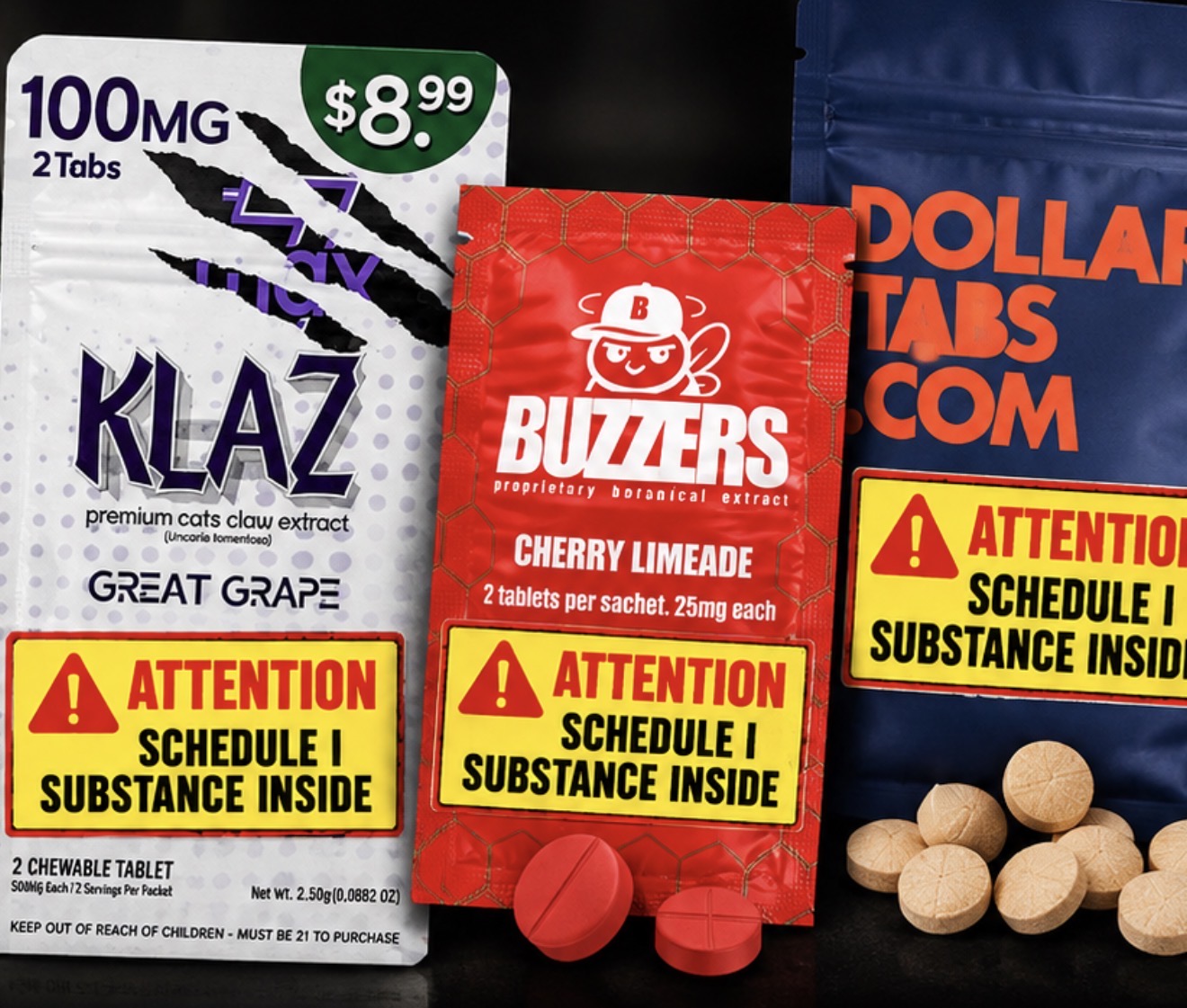
Utah officials warned that products labeled as cat's claw contained mitragynine pseudoindoxyl and MGM-15. Both were illegal in Utah and had recently been classified by DEA as Schedule I.
2. The Ridiculous Part: The Law Still Depends on the Seller Telling the Truth
Officials said products were misleadingly labeled as cat's claw, Uncaria tomentosa. The labels reportedly claimed the products were “legal and free of kratom” while warning that they were for adults or produced strong psychoactive effects.
Laboratory testing reportedly found kratom-derived Schedule I compounds instead.
3. Your Bill Can Ban It. Now Find It.
A statute can prohibit MP. It can prohibit MGM-15. It can prohibit the next analog lawmakers learn about. None of that tells an inspector what is inside a tablet.
The cashier cannot identify it. The package may not disclose it. A visual inspection cannot identify it. The state needs analytical testing capable of detecting the compound.
Questions every KCPA sponsor should answer
Who tests? Which agency routinely buys these products and screens them?
Test for what? Does the laboratory have methods and reference material for every prohibited analog?
How often? Is testing systematic, or does it begin after poison-center calls, overdoses or deaths?
Who pays? A list of prohibited molecules is cheap to print. A serious surveillance program is not.
4. The Manufacturer Said It Wasn't Kratom
NBC News reported that Exo Club, which makes Buzzers, said on its website that the product does not contain kratom and described extracting an indole alkaloid from cat's claw to mirror the effects of popular kratom products.
Utah officials reported something different from testing: kratom-derived MP and MGM-15 in products represented as cat's claw.
5. The Part Utah's New Law Finally Recognized
Utah's 2026 answer is revealing. After becoming the first KCPA state, Utah stopped treating extracts as an acceptable retail category. The state now says only pure leaf kratom may be sold, and extracts or products made from extracts cannot be sold in Utah.
In other words, Utah moved upstream. Instead of endlessly drawing new lines around every downstream formulation, the state narrowed the legal market closer to the plant itself.
6. “It's Illegal” Is Not a Testing Program
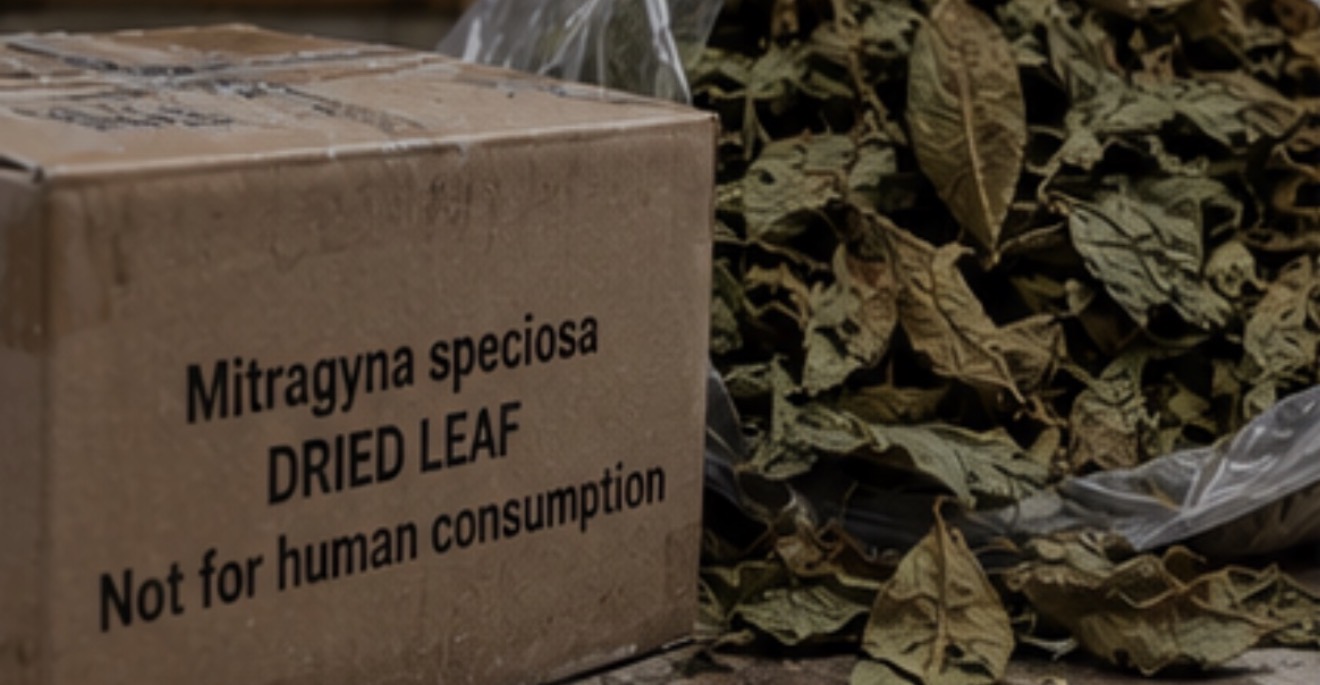
If nobody is routinely testing products, a prohibited compound can remain invisible to the state until something gives officials a reason to look.
In this case, officials are discussing four deaths linked to potent semi-synthetic kratom compounds.
Utah did not need another ingredient list. It needed to know what was actually in the package.
The Question for Every State With a KCPA
Do not tell the public that your bill “covers” MP, MGM-15 or some future analog and call the job finished.
Explain how your state will find it when the manufacturer does not put the name on the package. Explain which laboratory will test it. Explain how frequently products will be screened.
And explain why the testing should happen before somebody dies.
“The statute says it's illegal” is not an analytical method.
Primary records & reporting
NBC News - Semi-synthetic kratom products linked to four deaths in Utah, Oct. 6, 2026 - PDF copy
Utah Legislature - 2019 S.B. 58, enrolled Kratom Consumer Protection Act
Utah House Business and Labor Committee - Feb. 26, 2019 minutes and S.B. 58 vote
Utah Legislature - 2026 S.B. 45 as introduced
Utah Legislature - 2026 S.B. 45, third substitute
Utah State Bulletin - official rulemaking history of S.B. 45
Utah Department of Agriculture and Food - New Kratom Law Now in Effect, May 11, 2026