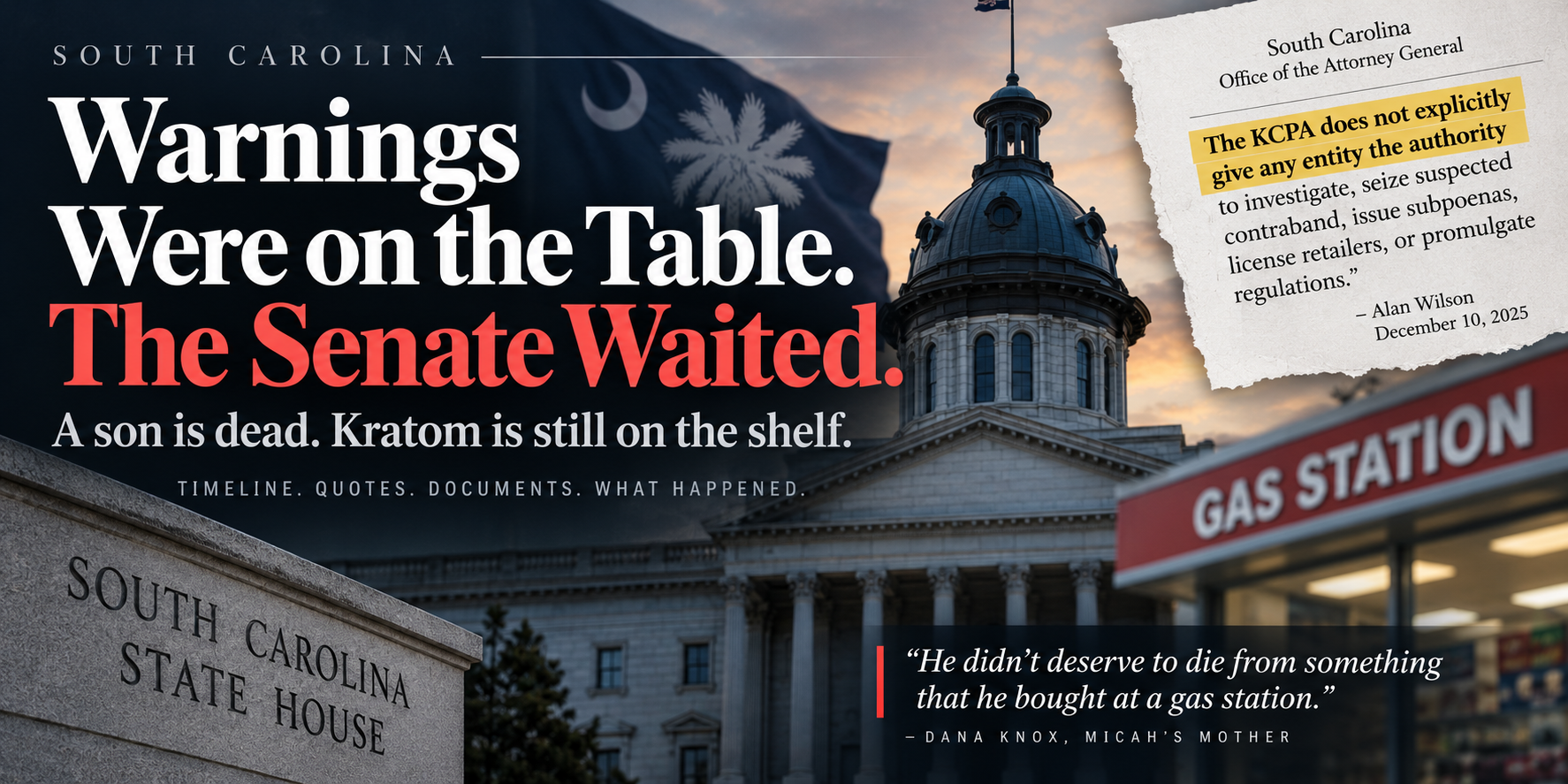
This is the enforcement chapter the first story left hanging. Before H.4641 ever reached the Senate, South Carolina’s own health department had already asked whether the state’s Kratom Consumer Protection Act actually gave it the tools needed to enforce the law. The Attorney General’s answer identified a basic problem: the statute did not expressly give DPH the investigative and seizure powers it was asking about.
The 30-second version
DPH asked for enforcement powers. The AG said the KCPA did not expressly provide them.
The House acted. H.4641 passed 98-4—but its Schedule I approach had been narrowed so whole-leaf kratom remained legal while specified alkaloids/chemically equivalent compounds were targeted.
The Senate waited. SLED described practical testing problems, and Medical Affairs took no vote.
Now the AG is warning parents. Which brings South Carolina back to the question it started with: who can actually get a noncompliant product off the shelf?
1. DPH Asked: Who Can Enforce This?
On December 10, 2025, the South Carolina Attorney General’s Office issued a formal opinion at the request of William Britt, General Counsel for the Department of Public Health. DPH’s questions were practical, not academic. The department wanted to know whether the KCPA allowed it to investigate suspected violations, seize suspected contraband, issue subpoenas, license or permit sellers, and adopt regulations to carry out the law.
The Attorney General’s office concluded that the KCPA did not explicitly designate an enforcing entity or expressly provide DPH those powers. The opinion suggested that if the General Assembly intended DPH to perform those functions, lawmakers could amend the statute to say so.
2. Six Days Later: H.4641
H.4641 was prefiled on December 16, 2025. As introduced, it took a blunt approach: add kratom to Schedule I and repeal the South Carolina Kratom Consumer Protection Act. The House later rewrote and amended the measure substantially, but the legislation still represented an attempt to address a regulatory structure whose enforcement limitations had already been identified by the Attorney General’s office.
After extensive House debate and amendments, H.4641 passed second reading 87-7 on April 29 and third reading 98-4 on April 30. It was then sent to the Senate and referred to the Medical Affairs Committee.
3. SLED Flagged Another Enforcement Problem
At the Senate Medical Affairs proceedings in May, another enforcement problem surfaced. SC Daily Gazette reported that Todd Hughey, who oversees the South Carolina Law Enforcement Division laboratory, told senators that SLED’s lab could not distinguish what was natural from what was manmade. He also said he did not know exactly how enforcement worked under the existing law.
That matters because the KCPA’s protections depended heavily on chemical and manufacturing distinctions. If the state cannot reliably determine which side of a statutory line a product occupies—and the enforcing authority itself is unclear—the words on the page do not automatically translate into products coming off shelves.
4. The Senate Waited
The Senate Medical Affairs Committee did not vote H.4641 out in the final week of the session. Chairman Danny Verdin framed the unresolved question plainly: “We all know it’s addictive.” He then said he wanted to know whether it was debilitating and whether it was killing people.
Sen. Jeff Zell likewise argued against moving the House bill quickly. His remark captured the Senate’s posture:
— Sen. Jeff Zell, May 2026
Zell added that he was interested in making sure lawmakers were compassionate. Senators cited conflicting testimony, concerns about people using lower-potency products, and the complexity of distinguishing botanical from manipulated products. The committee chose not to take a vote and expected to return to the issue later.
Then a South Carolina Father Asked the Question No Statute Can Answer
In September, FOX Carolina reported on Robert and Dana Knox and the death of their 29-year-old son, Micah. His parents said he had been sober for nine and a half months. The report said toxicology found mitragynine in his blood and described his death as an accidental overdose.
The Knox case does not by itself answer every question about kratom regulation or causation. It does, however, sharpen the enforcement question South Carolina officials had already been asking: when a product violates state law, who has the authority and practical ability to get it off a retail shelf?
5. Four Months Later: “Every Tool at Our Disposal”
On September 24, 2026, Attorney General Alan Wilson issued a public-safety advisory following the deaths of two University of Mississippi students. His office noted that kratom is available in South Carolina convenience stores to people 21 and older. Wilson called the danger personal as the father of a college student and said his office would use “every tool at our disposal” to protect South Carolina families.
That statement now sits beside the December 2025 opinion from his own office. DPH had already asked whether it possessed basic enforcement tools under the KCPA. The Attorney General’s office had already concluded that the statute did not expressly provide them. The House then sent the Senate H.4641 by an overwhelming vote. At the Senate hearing, SLED’s laboratory director described another practical enforcement limitation. The Senate took no vote.
The Timeline
| Date | What happened | Why it matters |
|---|---|---|
| Dec. 10, 2025 | AG opinion issued at DPH General Counsel William Britt’s request. | DPH had asked about investigation, seizure, subpoenas, licensing and rulemaking. The opinion found those powers were not expressly granted by the KCPA. |
| Dec. 16, 2025 | H.4641 prefiled. | Original bill proposed Schedule I treatment and repeal of the KCPA. |
| Apr. 29, 2026 | House passes H.4641 on second reading, 87-7. | The measure had been substantially amended during House consideration. |
| Apr. 30, 2026 | House passes third reading, 98-4; Senate refers it to Medical Affairs. | The Senate now had the House legislation before it. |
| May 2026 | SLED lab director tells senators the lab cannot distinguish natural from manmade material and says he does not know exactly how enforcement works. | A second, practical enforcement problem was put before senators. |
| May 2026 | Medical Affairs takes no vote. Zell says he is not interested in rushing House bills so representatives can “get credit on Facebook.” | H.4641 remains in committee. |
| Sept. 24, 2026 | AG Wilson issues public-safety advisory after the Ole Miss deaths. | Wilson says South Carolina will use “every tool at our disposal.” |
So, Alan: What Tools?
The September warning makes the unanswered enforcement question more urgent, not less. If a South Carolina retailer is selling a kratom product that violates the KCPA today, which agency has explicit authority to investigate it? Who takes the sample? Who orders the laboratory analysis? Who can seize the product? What statutory mechanism gets it off the shelf?
Those are not rhetorical details. They are the difference between a consumer-protection law and a label on a statute book.
South Carolina can continue debating where to draw chemical thresholds and which products deserve which classification. But the chronology is now difficult to ignore: DPH raised the enforcement problem, the Attorney General’s office documented it, SLED described another enforcement limitation, the House acted, and the Senate chose more time.
Now the Attorney General is warning parents.
So, Alan: what tools?
Primary records & reporting
South Carolina Attorney General — Dec. 10, 2025 KCPA opinion requested by DPH
South Carolina Legislature — H.4641 legislative history
H.4641 — April 29, 2026 House-amended text
SC Daily Gazette — May 7, 2026 Senate Medical Affairs coverage
South Carolina Attorney General — Sept. 24, 2026 public-safety advisory