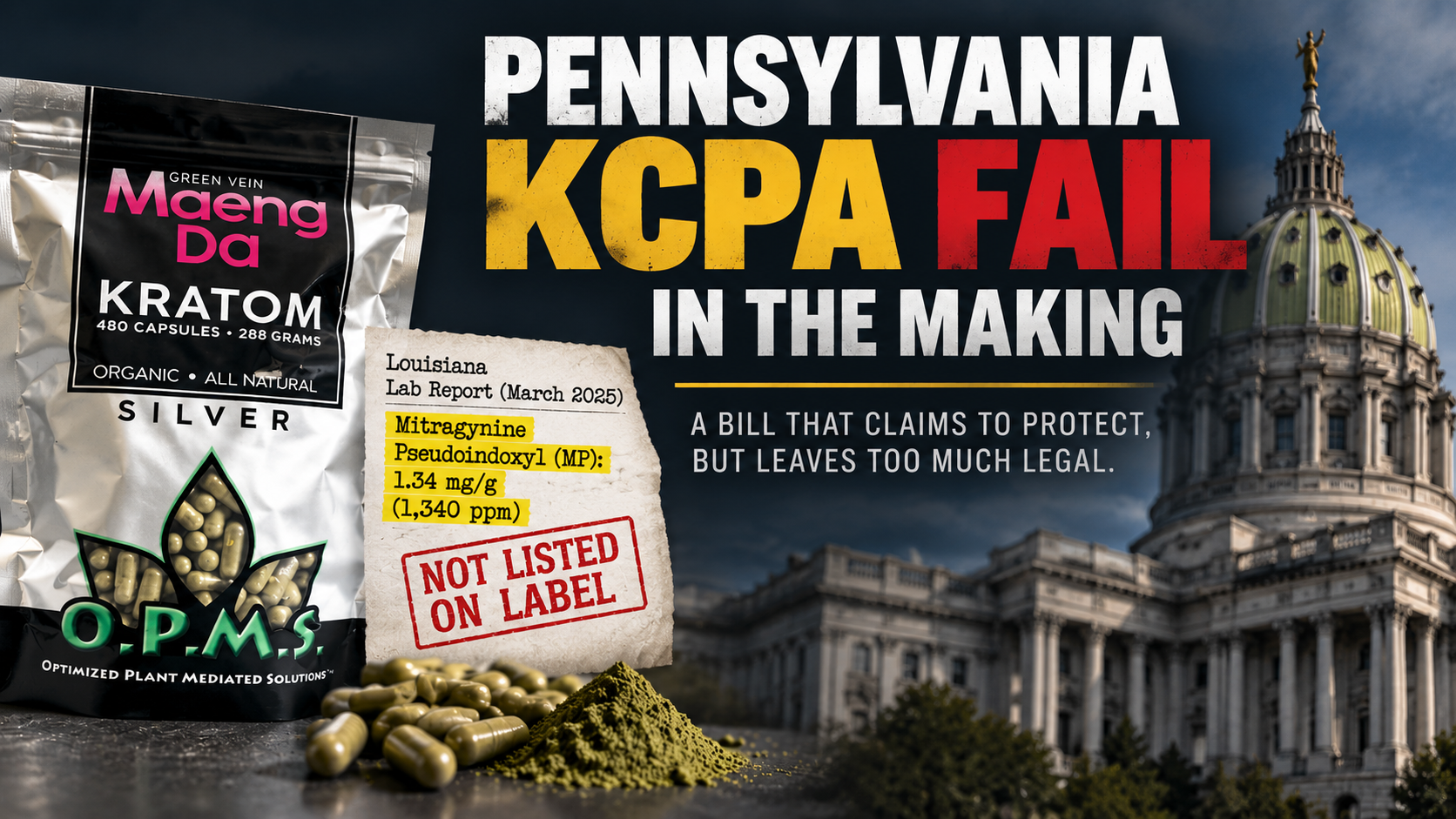
Rep. Bridget Kosierowski’s HB 2657 has real penalties. What it does not spell out is a statewide shelf-inspection and laboratory-testing system capable of continuously verifying the chemistry of kratom sold across Pennsylvania.
The 30-second version
It keeps kratom legal. “Natural” leaf and raw leaf powder may remain on retail shelves.
It bans defined “synthetic” products. That includes products over 10 ppm mitragynine pseudoindoxyl (MP), over the bill’s 7-OH threshold, synthetic alkaloids, and products outside its narrow natural-product definition.
It has penalties. Criminal penalties apply to knowing or intentional violations of the synthetic-product prohibition; Section 4 violations can bring civil penalties.
But enforcement still requires evidence. A package saying “natural” does not tell an inspector its MP concentration—or whether an alkaloid was synthetically produced.
1. First Problem: The Label Is Not the Chemistry
HB 2657 requires a retail product to carry a verification that it is in “natural form.” But the bill does not require every retail lot to arrive with an independent certificate of analysis establishing compliance with its chemical thresholds.
2. Who Is Going Store to Store?
The bill requires processors and retailers to register with the Department of Health and caps each registration or renewal fee at $100. Those fees are directed to enforcement.
But the introduced bill does not establish a dedicated kratom inspection unit, a mandatory inspection frequency, random shelf sampling, lot-by-lot testing, or a specific laboratory surveillance program.
Registration tells Pennsylvania who says they are selling kratom. It does not, by itself, tell Pennsylvania what is inside the products they sell.
3. Yes, There Is an Enforcement Mechanism. But Read What It Actually Does.
HB 2657 is not identical to South Carolina’s problem. Pennsylvania’s bill expressly provides enforcement authority for Section 4: the Attorney General, state or local law enforcement, and local government units may investigate suspected Section 4 violations. It also provides civil penalties and consumer remedies.
For Section 3, knowingly or intentionally manufacturing, delivering, selling, or possessing with intent to sell a prohibited synthetic kratom product is a misdemeanor carrying up to a $15,000 fine, five years' imprisonment, or both.
But statutory authority is only half the problem. To enforce a chemistry-based prohibition, somebody still has to obtain the product, analyze it, interpret the result and establish the violation.

4. And What Test Proves “Natural” Versus “Synthetic”?
This is the question the bill should force into the open.
A quantitative laboratory assay can measure how much MP or 7-OH is present. That can answer whether a tested sample crosses a numerical concentration threshold.
But concentration is not the same question as origin. If Pennsylvania wants enforcement to depend on whether an alkaloid is naturally occurring, extracted, concentrated, converted or synthetically derived, lawmakers should identify what validated analytical method will establish that distinction—and what evidentiary standard regulators and courts are supposed to use.
Questions HB 2657 should answer before Pennsylvania relies on it
Who inspects? Which agency personnel conduct routine retail inspections?
How often? Is inspection complaint-driven, random, annual—or something else?
Who samples? Who has responsibility for pulling suspect products and maintaining chain of custody?
Who tests? Which state or contracted laboratory performs quantitative alkaloid analysis?
What method? What validated test distinguishes a naturally occurring constituent from one that was synthetically derived or chemically converted?
Who pays? A registration fee cannot substitute for an actual statewide testing plan.
What happens while testing is pending? Can suspect inventory be held or removed before the laboratory result returns?
5. Meanwhile, Federal Law Has Already Moved
DEA placed mitragynine pseudoindoxyl, MGM-15 and MGM-16 in federal Schedule I effective August 26, 2026. HB 2657 nevertheless uses a state definition under which a product becomes “synthetic” based in part on exceeding 10 ppm MP.
That makes accurate identification more—not less—important. Pennsylvania would be regulating products in a market where the relevant chemistry can carry consequences under both state and federal law.
The Question for Rep. Kosierowski
HB 2657 can print “natural,” “synthetic,” “10 ppm” and “0.5%” into Pennsylvania law. The shelf does not read the statute.
Who inspects the retailers? Who takes the samples? Who runs the tests? What test establishes synthetic origin? And what happens when the package says “all natural” but the laboratory says something else?
Primary records & supporting material
Pennsylvania General Assembly — HB 2657 bill page and sponsor information
Pennsylvania General Assembly — HB 2657, Printer’s No. 3668
DEA — temporary scheduling announcement
Federal Register — Schedule I order
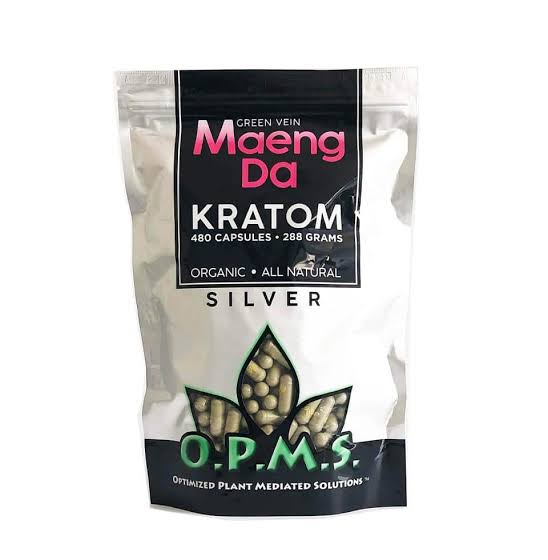
Anresco Laboratories — OPMS Silver Green Vein Maeng Da report, March 2025
Moller v. Martian Sales — federal court record identifying OPMS Silver