Florida has spent years drawing legal lines around kratom instead of removing the product category from ordinary retail commerce. The result is now on display in Northwest Florida: nine kratom-related overdose deaths reported in four counties, illegal levels of 7-OH still appearing in toxicology, and police waiting for a field test to tell them what is illegal.
The 30-second version
Florida already has a KCPA. Kratom remains legal in raw form and qualifying products remain available in gas stations, vape shops and convenience stores.
Florida already declared a 7-OH emergency. Attorney General James Uthmeier moved against isolated and concentrated 7-OH and the state later seized thousands of products.
Then Florida rewrote the line. The revised rule moved the solid-product concentration threshold from 0.4 mg/g to 1 mg/g while adding other restrictions, including a mitragynine-to-7-OH ratio.
Now sheriffs are reporting deaths anyway. WEAR reports nine kratom-related overdose deaths in Escambia, Santa Rosa, Okaloosa and Walton counties in 2026, with law enforcement saying illegal amounts of 7-OH are still appearing in toxicology.
1. Florida Regulated Kratom. The Bodies Did Not Read the Statute.
On September 29, WEAR reported that Northwest Florida law enforcement was warning residents against kratom after the District 1 Medical Examiner's Office reported nine kratom-related overdose deaths in 2026 across Escambia, Santa Rosa, Okaloosa and Walton counties.
Okaloosa County Sheriff Eric Aden was blunter than the regulatory framework. He warned against all of it. According to WEAR, Aden said the circuit had experienced nine deaths since May involving over-the-counter products and said 7-OH had been found in the deaths his area investigated.
This is not happening in a state that forgot to regulate kratom. Florida has already tried the regulatory answer.
2. Then Florida Declared an “Imminent Hazard” — and Raised the Line
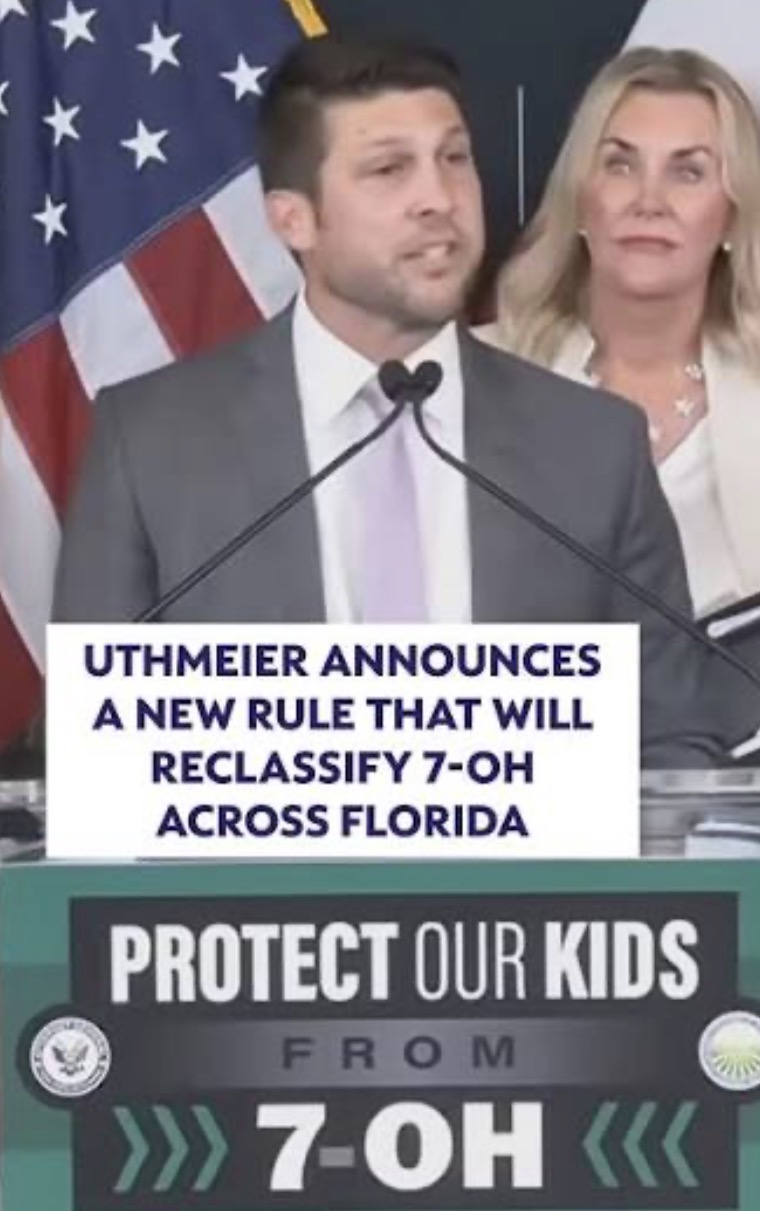
In 2025, Attorney General James Uthmeier announced an emergency rule aimed at isolated and concentrated 7-hydroxymitragynine. The Attorney General's office said the substance posed a high risk of abuse and death and announced that Florida was taking dangerous 7-OH products off store shelves.
That sounded decisive.
But the details changed.
As documented in our earlier Global Kratom Policy Review analysis, Florida's first emergency rule used a 0.4 mg/g concentration threshold. The revised rule raised the solid-product threshold to 1 mg/g—2.5 times the original concentration—while also adding restrictions on other metabolites and analogs and a 100:1 mitragynine-to-7-OH ratio.
The distinction matters. The revised rule may close some loopholes, but it does not erase the central contradiction: Florida increased the allowable concentration under the very emergency regime created to reduce exposure.
3. And the Rule Still Does Not Solve Total Exposure
Our Florida 7-OH analysis identified another weakness: the rule regulates concentration rather than simply imposing a maximum amount of 7-OH in every finished unit or package.
A concentration expressed in milligrams per gram does not tell a consumer the total dose in a larger gummy, tablet, bottle or multipack. A heavier product can contain more total 7-OH while remaining under the same concentration threshold.
That is the difference between regulating a ratio and regulating exposure.
4. Now Law Enforcement Is Waiting for a Field Test
The newest reporting supplies perhaps the clearest demonstration of the problem.
WEAR reports that the Florida Department of Law Enforcement is working on a field test to identify high concentrations of 7-OH. Sheriff Aden said such a test would be important for bringing criminal charges against dealers.
Think about what that means in practice.
The product can already be on the shelf. It can already be purchased. It can already be consumed. An overdose can already occur. Toxicology can later identify 7-OH. And law enforcement is still developing the roadside or field-level tool needed to determine whether the product crossed Florida's chemical line.
The questions Florida's regulatory model still has to answer
At the shelf: how does an officer or inspector know whether a product contains 0.8 mg/g or 8 mg/g of 7-OH?
At the sale: what tells a consumer whether the package is actually compliant?
At the overdose: why should toxicology after an injury or death be the point at which the state discovers the product chemistry?
At enforcement: if a field test is still being developed, how effectively can thousands of retail products be screened today?
At policy: if sheriffs are warning people against kratom broadly, why does Florida continue treating qualifying kratom as ordinary retail merchandise?
5. The Attorney General “Fixed” 7-OH. The Sheriffs Are Still Counting Deaths.
Florida's Attorney General deserves credit for recognizing that concentrated 7-OH products required intervention. The state also reported seizing nearly 18,000 7-OH products during its 2025 crackdown.
But enforcement theater and effective market control are not the same thing.
A year later, Northwest Florida sheriffs are warning residents about kratom after nine reported deaths in their circuit. Aden says illegal amounts of 7-OH are still showing up in toxicology. FDLE is still developing a field test.
6. Notice What the Sheriffs Are Actually Saying
The most revealing part of the WEAR report is the gap between the legal categories and the warnings coming from the people dealing with the consequences.
Florida law distinguishes legal raw-form kratom from prohibited high-concentration 7-OH products. Escambia County Sheriff Chip Simmons explained that distinction in the report.
But Sheriff Aden's advice was simpler: he said he would not buy or use products like these and warned that they could kill.
That tension is the KCPA problem in miniature. Legislatures divide a rapidly evolving alkaloid market into legally acceptable and unacceptable boxes. Law enforcement encounters the products after sale, after use and sometimes after death.
7. Florida's KCPA Did Not Prevent This Market. It Gave It Rules.
This is the question Florida lawmakers should confront.
The KCPA did not remove kratom from gas stations, vape shops and convenience stores. It created conditions under which kratom could remain there.
The 7-OH emergency action did not end the kratom-derived opioid market. It drew another chemical boundary inside it.
When that boundary proved politically or operationally difficult, Florida revised it.
Now law enforcement is trying to develop a field test capable of enforcing the boundary while medical examiners report deaths.
The nine deaths in Northwest Florida justify asking a different question: why are we allowing this retail market at all?
The Florida KCPA Experiment Is Producing Its Own Review
The case against Florida's approach does not require speculation.
Florida regulated kratom.
Florida declared concentrated 7-OH an emergency.
Florida changed the threshold.
Florida seized thousands of products.
And in September 2026, Northwest Florida sheriffs were still standing in front of television cameras warning residents about kratom after nine reported deaths.
One sheriff says illegal 7-OH is still appearing in toxicology. State law enforcement is still working on a field test.
That is not a finished regulatory system.
It is a regulatory system trying to catch up with the products it chose to leave in commerce.
Florida should stop congratulating itself for moving the line and start asking why the line keeps failing.
Primary records & supporting material
Florida Attorney General — Emergency action on isolated and concentrated 7-OH
Florida Attorney General — Statewide seizure of nearly 18,000 7-OH products