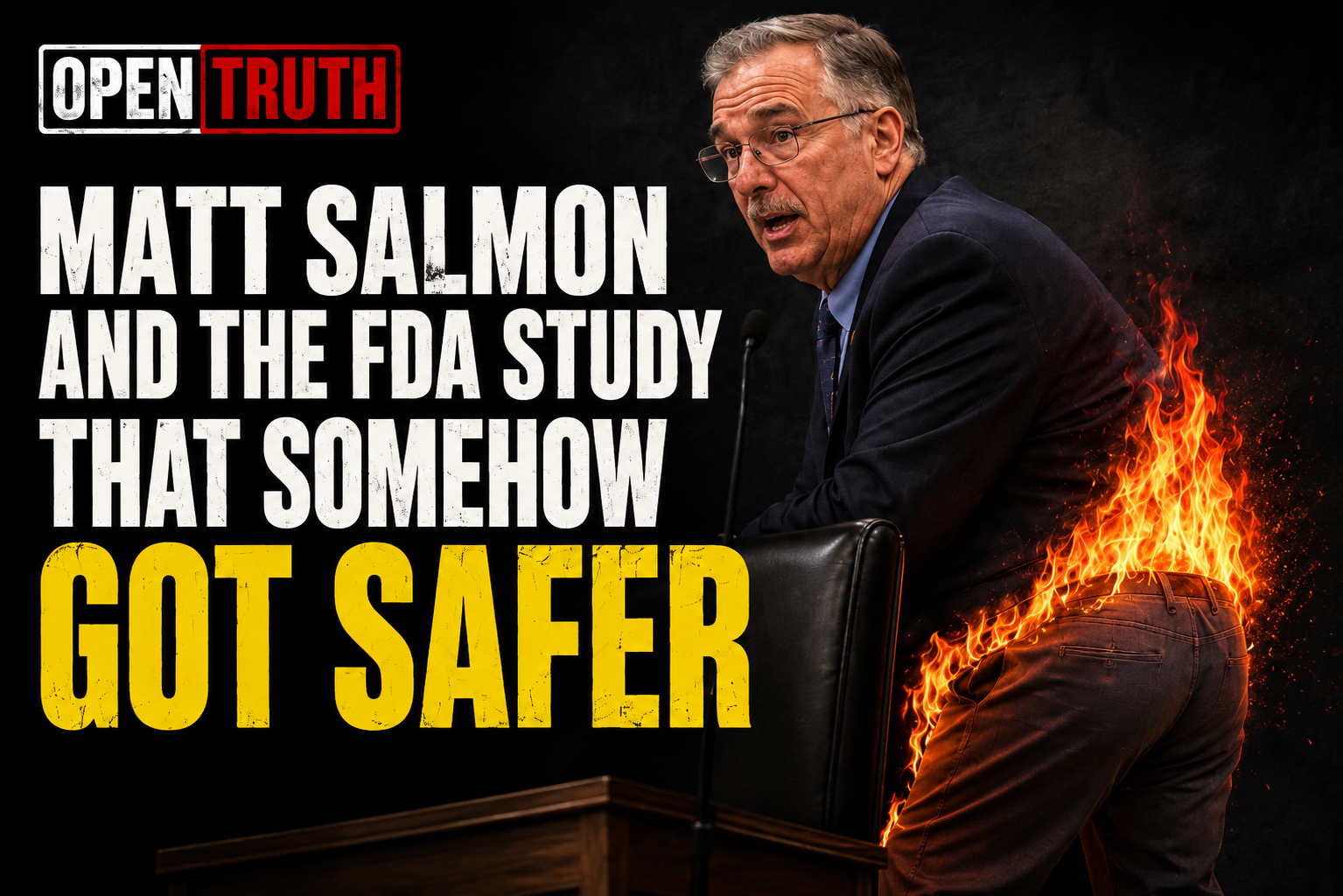
Matt Salmon apparently read a version of the FDA kratom study that its authors forgot to publish.
Speaking before Montana's Economic Affairs Interim Committee on August 18, 2026, Salmon claimed:
He then attributed that conclusion as "directly out of the FDA."
Now we have the actual published study.
It says something considerably different.
▶ Watch Salmon's testimony (begins at 6:53:00)
The FDA-funded study did not conclude that kratom was "safe at all levels."
Researchers administered single doses of 1, 3, 8, 10 and 12 grams to small cohorts of healthy recreational polydrug users. There were no deaths or serious adverse events, but participants experienced somnolence, vomiting and nausea. At 12 grams, researchers observed increased drug liking, good effects and feeling high.
More importantly, the authors explicitly warned that the study was too small to thoroughly characterize safety and was not powered to detect rare or infrequent adverse events.
Then there is Salmon's claim that researchers administered "20 times the recommended dosage."
The highest dose was 12 grams.
Twenty times what?
For the math to work, the mysterious "recommended dosage" would have to be 0.6 grams.
The study doesn't identify an FDA-recommended 0.6-gram dose. In fact, it cites surveys in which users reported taking 1 to 3 grams, 4 to 6 grams, or averages around 4 to 5 grams per serving.
So who recommended 0.6 grams?
Because it wasn't an FDA recommended dose identified in the study.
There is something the paper does say about FDA's position: FDA has concluded there is inadequate information to provide reasonable assurance that kratom does not present a significant or unreasonable risk, that kratom is not lawfully marketed as a dietary supplement, and that it cannot lawfully be added to conventional foods.
At 12 grams, researchers found statistically and clinically significant increases in drug liking and feeling high. Participants also reported feeling drunk and experiencing good drug effects. The authors wrote that these findings "may be indicative of an abuse potential."
Participants rated the effects of 8, 10 and 12 gram doses as similar to benzodiazepines and opioids.
After hearing the argument that the FDA supposedly gave people twenty times a "recommended dosage" and found kratom "safe at all levels," Montana lawmakers had a decision to make.
The regulatory proposal did not advance.
The ban proposal did.
The evidence does not establish that Salmon intentionally misrepresented the study. What it establishes is much simpler:
Montana lawmakers heard the pitch.
Then they advanced the ban.