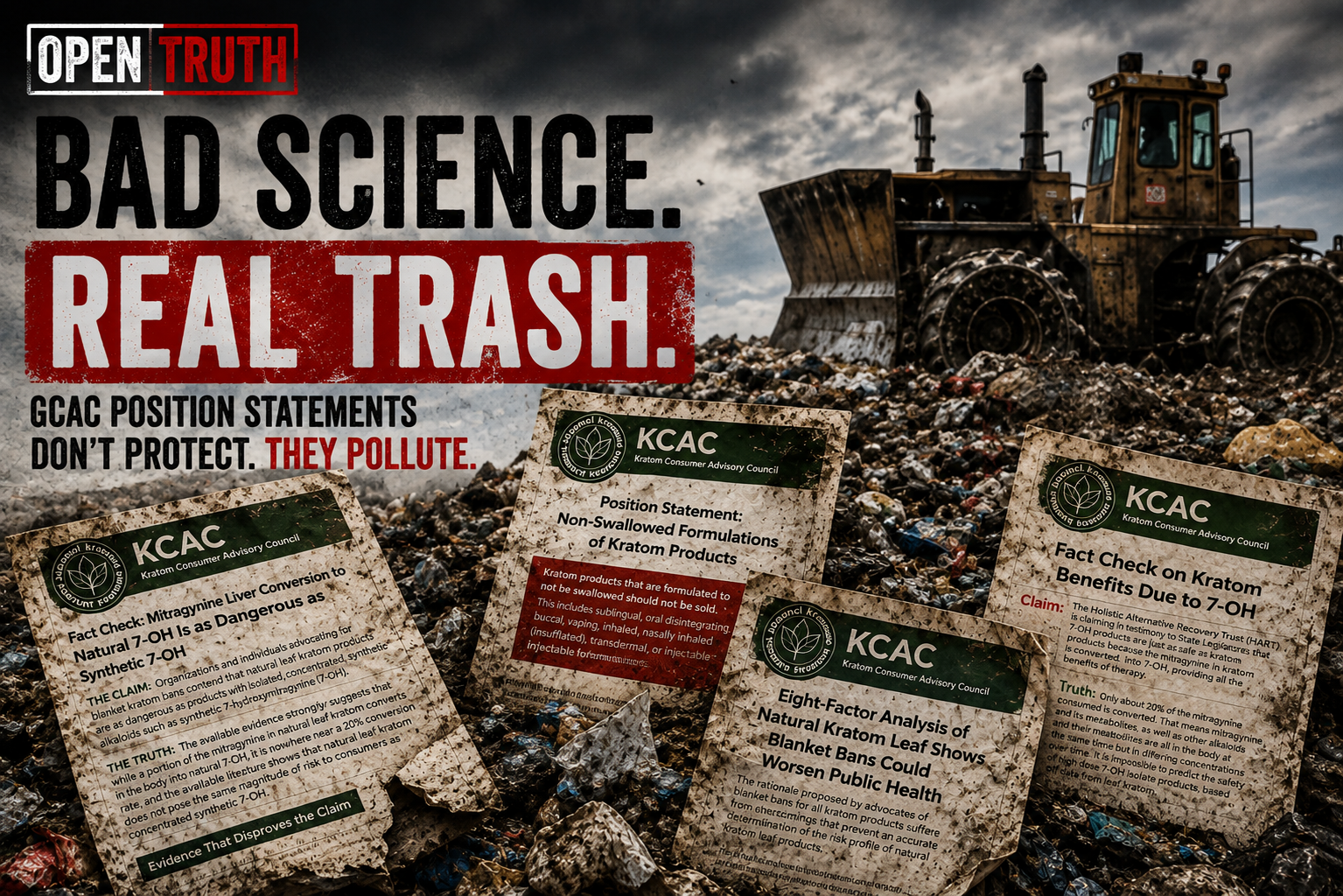
Seven polished position papers. Green headers. Charts. Footnotes. Lots of scientific vocabulary.
And one very consistent conclusion:
Whatever the problem is, apparently the answer can never be maybe we shouldn't be selling this stuff.
KCAC wants legislators to believe virtually every problem in the kratom market can be repaired with another label, another registration form, another laboratory test, another age restriction, or another government inspector.
The interesting part is how much KCAC admits while making that argument.
Its own papers describe dependence, addiction concerns, drug interactions, heavy metals, pediatric exposures, unlabeled products, unregistered products and an enforcement system that vendors routinely ignore.
Then the papers somehow arrive at:
Keep selling it. Just regulate it better.
That is not the only conclusion the evidence permits.
This isn't peer review. It's advocacy with footnotes.

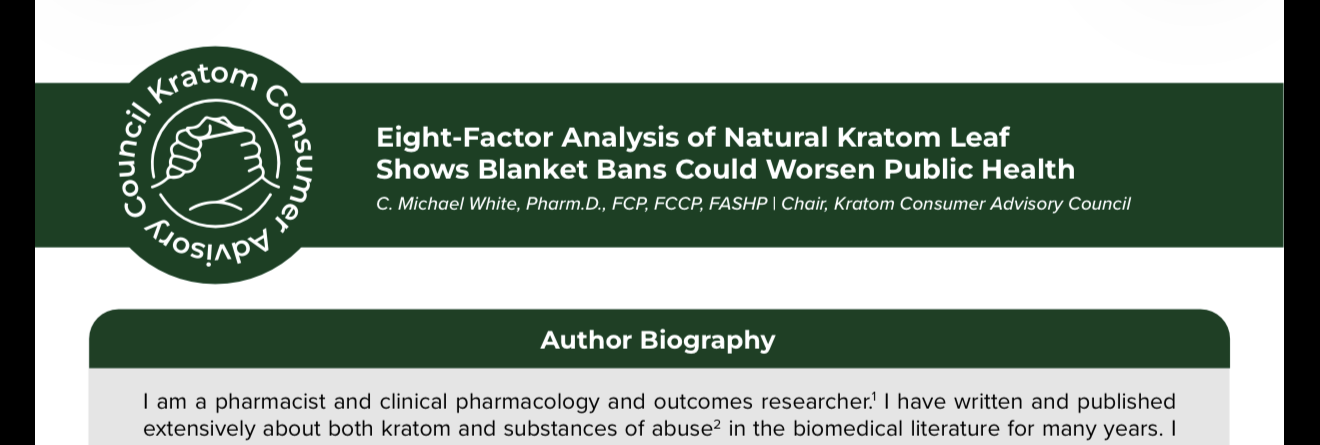
The conclusion appears before the analysis even starts:
KCAC also identifies itself as an independent council while acknowledging that the Global Kratom Coalition established it.
That does not automatically make the analysis wrong.
It does tell legislators what they are reading: an advocacy position paper supporting a particular policy outcome.
Much of the argument then becomes comparative:
That makes kratom look pretty good.
So would comparing warm beer to antifreeze.
The legislative question is not: Is kratom safer than heroin?
The question is: Has kratom itself been shown safe enough, consistent enough and controllable enough to justify continued retail sale?
Those are very different questions.
KCAC also cites surveys where kratom users describe kratom as beneficial, therapeutic or even lifesaving.
Those experiences matter.
But people saying a product helped them is not the same thing as proving that product is an effective medical treatment.
And buried in the same analysis is the admission that natural kratom can be abused and that addiction can harm patients.
KCAC spends considerable effort explaining that stronger human studies deserve more confidence than animal studies, case reports and weaker observational evidence. Its 7-OH paper explicitly presents that evidence hierarchy.
Good.
Then KCAC makes an extraordinary admission:
Read that again.
No clinical trials showing kratom treats a disease.
And yet KCAC repeatedly uses weaker evidence to discuss supposed benefits, opioid substitution and favorable risk.
That produces a remarkably convenient rule:
This paper lectures others about being careful with weak evidence.
Then it goes right back to animal studies.
It also makes several important admissions.
KCAC acknowledges that mitragynine is converted into 7-OH inside the body. It further describes 7-OH as leading to mitragynine pseudoindoxyl, another opioid-active compound.
So the honest discussion is not:
"Does oral kratom have anything to do with 7-OH?"
It plainly does.
The question is how much the downstream compounds contribute to effects and risk.
That is a legitimate scientific debate.
Pretending the relationship disappears because concentrated 7-OH products are worse is not.
KCAC itself also acknowledges that it lacks enough evidence to make definitive claims that kratom treats severe pain or opioid-use disorder.
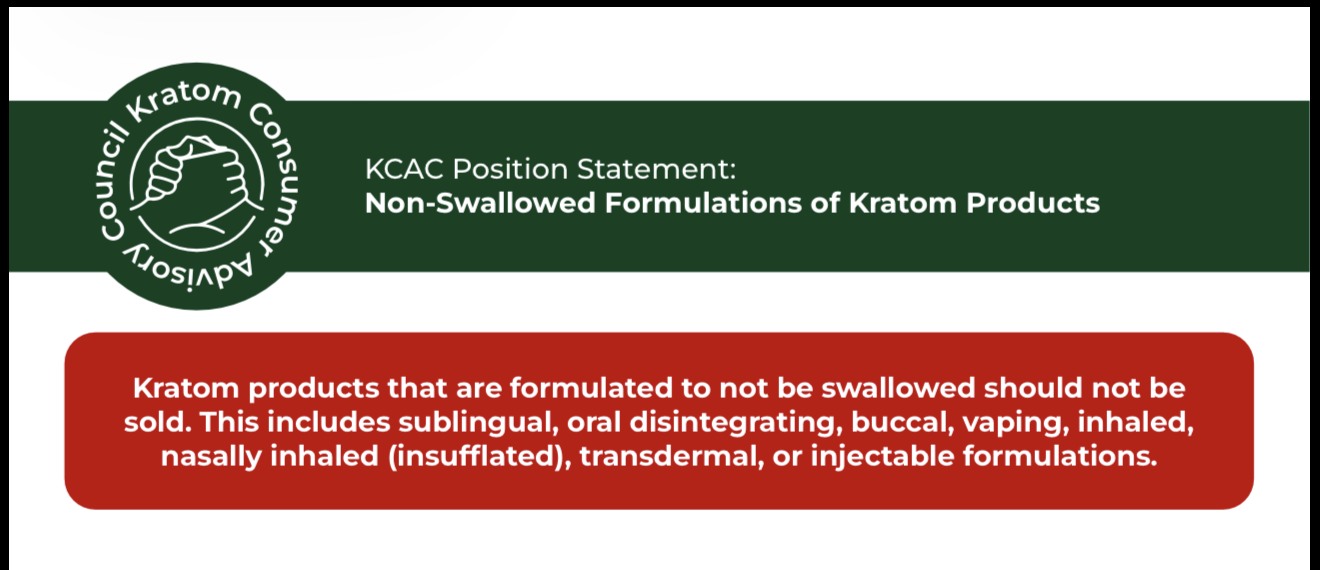
KCAC says vaping, sublingual, nasal, transdermal, injectable and other non-swallowed kratom products should not be sold.
Why? Because bypassing normal digestion can produce higher blood levels and increase risk.
Makes sense.
Then the paper calls powders, capsules, tablets and liquids "acceptable" when properly manufactured and labeled.
That is where the logic jumps the curb.
Showing that one route can be more dangerous does not establish that another route is safe.


KCAC acknowledges pediatric kratom exposures involving: agitation, hallucinations, seizures, rapid heart rate and nausea.
It says children may be especially vulnerable to addiction and notes concerns about excessive lead exposure from some kratom products.
Then KCAC recommends:

KCAC is absolutely right that children should be protected.
But the paper raises an obvious question:
What exactly are lawmakers protecting them from?
Because the answer in KCAC's own paper is not "nothing."

KCAC says it is aware of products being sold:
That is quite a list.
And the proposed cure? A better label.
KCAC even proposes labels telling consumers a recommended amount and the number of servings that can "safely" be consumed in 24 hours.
Okay.
Who established the safe number?
Because printing "two servings per day" on a bottle does not turn two servings per day into a clinically established safe dose.


KCAC says product and vendor registration can help protect consumers.
Then it describes an audit of 28 Utah vendors.
The results?
Those are KCAC's numbers.
Registered-market regulation was in place.
The stores sold the products anyway.
KCAC's conclusion? More enforcement is necessary.
Yes.
That is exactly the problem.

A regulatory scheme works only if somebody:
Writing "prohibited" into a statute does not teleport inspectors into convenience stores.
KCAC disputes claims about how much 7-OH is produced when humans consume mitragynine.
First, the paper says the amount cannot be calculated with certainty because an important human measurement is unknown.
Fair enough.
Then KCAC says only animal data are available for that missing measurement.
Still fair.
Then it takes the value from a rat, scales it to a 70-kilogram human and calculates an estimated human amount.
Then comes my favorite part.
KCAC acknowledges:
And then identifies a specific range anyway:

You do not need a PharmD. You do not need to know pharmacokinetics. You barely need long division.
If the human number is unknown, borrowing a number from a rat does not suddenly make it a measured human number.
KCAC is entitled to argue that critics should not describe the observed blood ratio as a literal 20% dose conversion.
But KCAC cannot simultaneously say the exact human amount is unknowable and then pretend its own rat-based estimate settles the matter.
KCAC's individual recommendations are not all unreasonable.
The problem is what happens when KCAC asks lawmakers to treat those proposals as proof that the underlying product belongs on the market.
Read all seven papers together.
KCAC itself describes a product category that may:
Then the conclusion is:
Maybe.
But legislators are allowed to ask another question:
That question does not require pharmacology.
It requires common sense.
The KCAC papers look impressive.
That is their strongest feature.
The green banners look official. The references look academic. The technical vocabulary makes ordinary readers feel like they probably should not question the conclusions.
Question them anyway.
Because once the jargon is removed, the recurring argument is remarkably simple: