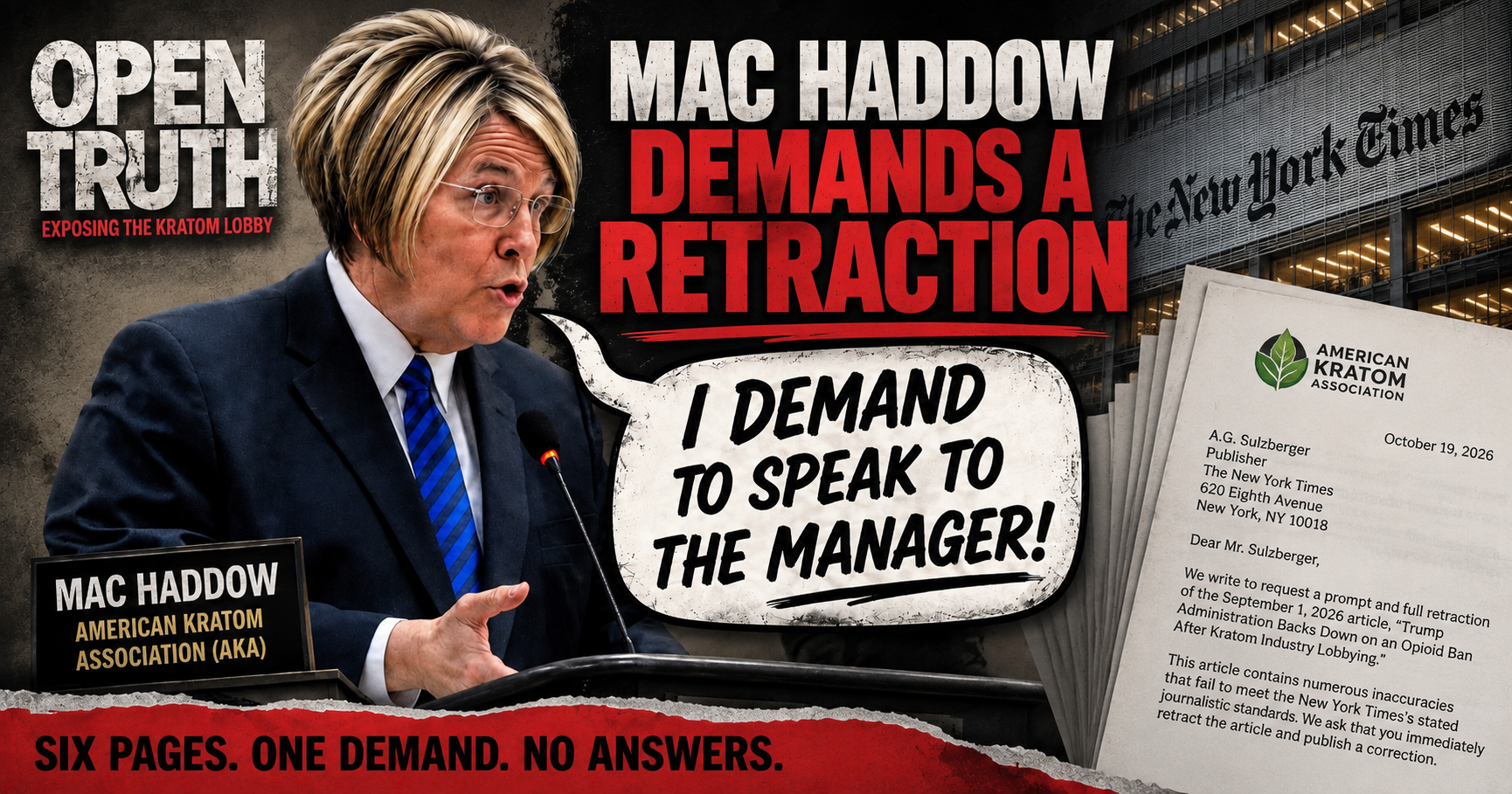
The AKA Wants a Retraction.
Here's What It Won't Answer.
The New York Times reported how the kratom industry lobbied Washington while federal officials changed the rules for a powerful opioid. Two days later, Mac Haddow demanded a correction or retraction. His six-page letter argues about how the new limits work. It largely avoids why those limits changed.
The Times link opens a search for the October 28 article, not a verified direct article URL.
Why is the AKA upset?
Because the story did not stop at kratom chemistry. It connected political donations, industry lobbying, OPMS wrongful-death lawsuits, and a change in federal drug policy.
The Times reported that mitragynine pseudoindoxyl (MGPI) was originally placed in Schedule I without a concentration exemption. After industry objections and litigation, federal officials proposed allowing certain amounts of MGPI in products.
Haddow says the new rule is tougher than the Times suggests. But he never squarely answers the obvious question: Why did MGPI go from no exemption to a proposed exemption?
What happened before the letter?
| When | What happened |
|---|---|
| July–August | Federal officials moved to place MGPI in Schedule I without a concentration exemption. |
| Mid-July | Testing identifying MGPI in OPMS products became an issue in wrongful-death litigation, according to the Times. |
| Aug. 25–26 | The Times reported additional Gabbay political donations, a DOJ trace-amount enforcement statement, and the AKA's lawsuit against DEA. |
| September | Haddow publicly described White House involvement in resolving the issue. |
| October | The government proposed a new threshold framework. The Times investigated. Haddow demanded a retraction. |
These events are reported in the October 28 Times article. Their timing does not by itself prove that donations influenced the policy. HHS denied that they did.
What is Haddow's actual argument?
He points out that the revised proposal has two tests. One counts 7-OH and MGPI together, with a threshold of 1 mg per gram of solid product or 1 mg per milliliter of liquid. The other looks at the ratio of mitragynine to those compounds. Either test can trigger scheduling.
That is a fair technical clarification. But it does not undo the central fact: MGPI previously had no concentration exemption.
Schedule I treatment without a numerical carve-out.
Some lower-level MGPI products may fall outside the proposed scheduling criteria.
Calling the second approach stricter because it combines two chemicals is beside the point when one of those chemicals previously had no exemption at all.
Why permit so much more than researchers found?
The Times quoted University of Mississippi researcher Amar Chittiboyina, whose work was cited in the policy discussion. He reportedly found about 2 parts per million of MGPI in eight liquid products and called the new threshold too permissive.
The separate ratio test can still restrict a product below that ceiling. But Haddow's letter does not explain why this concentration ceiling was chosen when the reported measurements were so much lower.
OPMS Silver tested positive for MP. Not merely a trace.
Here is another reason the Times investigation cannot be waved away with a lecture about ratios. Anresco Laboratories tested an OPMS Silver Green Vein Maeng Da capsule, lot 2025-03, for TestMyKratom.org. Its March 12, 2025 report identified mitragynine pseudoindoxyl (MP, also called MGPI) in the tested capsule.
| Reported analyte | Result | Why it matters |
|---|---|---|
| MP / MGPI | 1.34 mg/g | Above the proposed combined 1 mg/g concentration trigger even without detected 7-OH. |
| Mitragynine | 13.31 mg/g | 13.31 ÷ 1.34 = approximately 9.93:1, below the proposed 100:1 ratio. |
| 7-hydroxymitragynine | Not detected | MP alone is enough to meet both described tests in this sample. |
| Overall laboratory summary | “Pass” | The laboratory's reported pass designation is not a finding that MP is safe, disclosed on the label, or legally exempt. |
Why this matters to the Times story: OPMS-related companies are involved in the wrongful-death litigation described by the newspaper, and the litigation includes disputes over MGPI found in OPMS products. This independent-looking certificate adds a dated, product-specific measurement from a separately submitted OPMS Silver sample. It shows that the controversy is not merely theoretical.
And it raises an uncomfortable distinction for the AKA: Haddow demands that the Times emphasize the new combined ceiling and ratio test. Fine. Applied to this particular laboratory result, both proposed tests would be triggered. So what, exactly, about that fact makes the newspaper's scrutiny unreasonable?
Sample 1283849, OPMS Silver, lot 2025-03; 1.34 mg/g MP and 0.80 mg per capsule.
The certificate does not reproduce the product's complete ingredient label, prove deliberate addition or concealment, or link this particular capsule to a death.
The reported product is sold as a botanical kratom capsule. If MP was not disclosed on its labeling, the laboratory finding would raise an additional transparency concern. The certificate alone cannot verify that omission; a contemporaneous package label would be needed. Nor does it establish that this lot was one of the products tested in the lawsuits.
Read the original OPMS Silver laboratory certificate (PDF) ↗
Source: Anresco Laboratories, certificate of analysis, sample 1283849, lot 2025-03; collected March 4, 2025; reported March 12, 2025. The results concern this sample only. This comparison applies the criteria described in the AKA letter; it does not establish a final legal determination or resolve the pending litigation.
What about the OPMS lawsuits and lobbying?
The Times reported MGPI findings in OPMS products involved in wrongful-death lawsuits. It also reported that expert Marilyn Huestis initially said MGPI should not be in one tested product, while later supporting an allowance for trace amounts in botanical kratom.
Those findings do not prove MGPI caused the deaths or establish how it entered the products. They do raise questions that deserve answers.
Haddow's letter does not meaningfully address those findings. Nor does it directly refute the newspaper's reported donations, lawsuits, or White House discussions.
Does the Times owe a retraction?
| What the AKA wants | Our assessment |
|---|---|
| Explain the combined limit and ratio test. | Reasonable. Readers benefit from accurate technical detail. |
| Stop calling the change a loosening of controls. | Unconvincing. MGPI went from no concentration exemption to a proposed one. |
| Change the headline about lobbying. | Not justified by the letter. It does not refute the central reported sequence. |
| Retract the entire investigation. | Extraordinary demand, weak showing. A missing nuance is not proof the investigation is false. |
What changed in the science?
If MGPI warranted Schedule I controls without a concentration exemption in August, what new evidence justified the October proposal?
That is the question the AKA should answer. A six-page demand for a retraction is not an answer.
Read the evidence yourself
Mac Haddow's October 30 letter to The New York Times (PDF)
Anresco Laboratories: OPMS Silver capsule MP test, March 12, 2025 (PDF) ↗
Christina Jewett's October 28 investigation (NYT search)
DEA-1570 Federal Register notices
OpenTruth editorial analysis. Allegations and disputed claims are attributed to their sources. The October framework is discussed as a proposal, not an established finding of product safety.